
Quick Answer: What is Patal Bhuvaneshwar?
Open Daily · 7 AM – 6 PMPatal Bhuvaneshwar is an ancient subterranean limestone cave temple dedicated to Lord Shiva (Bhuvaneshwar Mahadev), located at an elevation of 1,350 metres in Gangolihat tehsil of Pithoragarh district, Uttarakhand. Pilgrims descend 90 feet (27 m) into the earth using heavy-duty steel chains through a narrow limestone tunnel. According to the Skanda Purana, the 160-metre-long cavern naturally preserves the stalactite and stalagmite rock formations representing 33 crore (330 million) Hindu deities.
What is Patal Bhuvaneshwar Cave Temple?
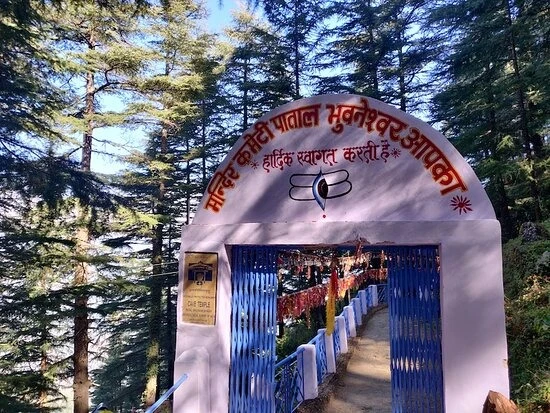
Patal Bhuvaneshwar (पाताल भुवनेश्वर) is one of India's most extraordinary, spiritually charged, and geologically mesmerizing subterranean shrines. Tucked away amidst fragrant pine and deodar forests 14 km from Gangolihat town in the Pithoragarh district of Uttarakhand, this ancient limestone cave descends vertically into the subterranean realm (Pātāla Loka).
Unlike man-made stone temples, the shrines inside Patal Bhuvaneshwar are entirely Svayambhu (self-manifested), sculpted over millions of years by the slow, sacred deposition of mineral-rich water dripping from limestone ceilings (karst speleothems). Revered as the subterranean abode of Lord Shiva, the cave is recognized by the Archaeological Survey of India (ASI) as an invaluable national monument and geological wonder.
As local ground operators headquartered in Pithoragarh, our expedition guides escort yatris safely into the cave during our dedicated Adi Kailash, Om Parvat & Patal Bhuvaneshwar Circuit.
Key Facts & Operational Specs
| Geographical Location | Village Bhuvneshwar, Gangolihat Tehsil, Pithoragarh District, Uttarakhand (PIN: 262522) |
| GPS Coordinates | 29.6918° N, 80.0894° E • Elevation: 1,350 m (4,429 ft) |
| Cave Structure | Natural epikarst limestone cavern • 90 feet vertical depth • 160 metres exploration length |
| Presiding Deities | Bhuvaneshwar Mahadev, Sheshnag, Ganesha, Kamdhenu, and 33 Koti Devas |
| Scripture Reference | Skanda Purana, Manas Khanda, Chapters 103–105 |
| Darshan Timings | 7:00 AM to 6:00 PM (Last entry into descent tunnel allowed at 5:00 PM) |
| Entry Coordination | ASI Ticket: ₹50 • Authorized Priest Guide Fee: ₹50–100 per family |
| Entry Protocol | Descent via dual stainless-steel chains • Socks required • Shoes deposited at surface |
| Photography Policy | Strictly prohibited inside the cavern • Lockers available at entrance |
| Tour Packages | 4-Day (ex-Pithoragarh) & 7-Day (ex-Kathgodam/Delhi) combined with Adi Kailash |
Puranic Legend & Rediscovery by Adi Shankaracharya
The sacred significance of Patal Bhuvaneshwar is documented extensively in the Manas Khanda of the Skanda Purana. The text proclaims that visiting Patal Bhuvaneshwar bestows equal spiritual merit to performing pilgrimage across all four sacred Dhams—Badrinath, Kedarnath, Gangotri, and Yamunotri.
According to Vedic chronicles, the cave was first discovered in the Treta Yuga by King Rituparna of Ayodhya (an ancestor of Lord Rama). While chasing a wounded deer, Rituparna was guided deep into the forest by the celestial serpent Sheshnag, who escorted the king through the subterranean chambers and unveiled the living pantheon of 33 crore deities worshipping Lord Shiva.
In the Dvapara Yuga, the five Pandava brothers and Draupadi meditated in this cavern during their Himalayan exile before embarking on their final ascent toward Swargarohini. Following the Pandavas' departure, the divine entrance was sealed in stone.
In 1191 CE (Kali Yuga), the great philosopher-saint Jagadguru Adi Shankaracharya was guided spiritually to the hidden portal during his voyage across Kumaon. He consecrated the subterranean sanctum, installed protective copper plates near the holy Shivling, and entrusted the sacred daily worship to the Bhandari Brahmin families of Bhuvneshwar village, whose descendants serve as authorized custodians to this day.
Inside the Cavern: The Divine Calcite Rock Formations
As you step off the final link of the steel descent chains onto the cavern floor, you enter a cool, ethereal subterranean cathedral illuminated by amber electric lamps. The cave ceiling and walls reveal naturally formed limestone sculptures:
Sheshnag's Hood & Spine
A massive, arching limestone ceiling sculpted like the seven-headed celestial serpent Sheshnag holding up the earth, accompanied by a long, segmented stalactite resembling the serpent's spinal column.
Ganesha's Head & Brahma Kamal
A smooth rock formation of Lord Ganesha's severed head, positioned directly beneath a 108-petaled calcite Brahma Kamal lotus that continuously drips single drops of mineral nectar onto the idol.
The Four Yuga Pillars
Four distinct stalagmites representing Satya, Treta, Dvapara, and Kali Yuga. Legend holds that the Kali Yuga pillar grows a fraction of a millimetre annually; when it reaches the ceiling, a cosmic epoch resets.
Kamdhenu Cow Udders
Calcite stalactites shaped like the udders of Kamdhenu (the wish-fulfilling divine cow). Clear limestone water naturally drips from these formations directly over a consecrated Shiva Lingam.
Kalpavriksha (Wishing Tree)
A sprawling calcite structure on the cavern wall with intricate branch-like mineral draperies, revered by devotees as the mythological wish-granting celestial tree.
Char Dham Replicas
Three natural stone formations clustered together resembling the sacred shrines of Kedarnath, Badrinath, and the naturally frozen ice-lingam of holy Amarnath cave.
Shiva's Jata & Ganga Descent
Cascading mineral draperies depicting the wild, matted locks (Jata) of Mahadev holding back the surging torrents of the descending celestial river Ganga.
Swans of Brahma & Garuda Wings
Wing-like calcite projections jutting out from side crevices representing Lord Brahma's celestial Hamsa (swans) and Lord Vishnu's divine mount, Garuda.
The 80-Foot Chain Descent: Step-by-Step Guide
The journey into Patal Bhuvaneshwar begins at the surface temple courtyard. Pilgrims remove their shoes and descend into an angled rock fissure roughly 3 feet wide and 80 feet long, inclined at a 45-to-60-degree pitch.
Essential Descent Safety Protocols
While the descent is safe and undertaken by thousands of devotees each month, following proper body mechanics is essential for a smooth experience:
Who Can Safely Visit?
- Suitable for: Adults, senior citizens with normal knee flexion, and children aged 7 and above with basic balance.
- Not Recommended for: Individuals suffering from acute claustrophobia, severe asthma, heart ailments, third-trimester pregnancy, or advanced knee arthritis. Devotees unable to descend can offer prayers at the surface temple of Goddess Bhuvneshwari.
How to Reach Patal Bhuvaneshwar: Distance & Route Matrix
Patal Bhuvaneshwar is well-connected by paved motorable mountain roads in eastern Kumaon. The table below outlines driving distances, estimated travel times, and recommended route corridors from major transit hubs:
| Origin / Hub | Distance | Drive Time | Standard Route Corridor | Transit Option |
|---|---|---|---|---|
| Gangolihat Town | 14 km | 25–30 mins | Gangolihat – Bhuvneshwar Road | Local Taxi / Bolero |
| Pithoragarh (Dist. HQ) | 75 km | 2.5 hours | Pithoragarh – Ghat – Gangolihat | Private Cab / Rudraansh Yatra Bolero |
| Berinag | 36 km | 1 hr 15 mins | Berinag – Raiagar – Bhuvneshwar | Shared Taxi / Private Cab |
| Chaukori | 38 km | 1 hr 20 mins | Chaukori – Berinag – Patal Bhuvaneshwar | Scenic Hill Taxi |
| Almora | 110 km | 3.5 hours | Almora – Barechina – Daniyan – Gangolihat | State Bus / Private Cab |
| Bageshwar | 75 km | 2.5 hours | Bageshwar – Kanda – Vijaypur – Gangolihat | Hill Taxi / Bus |
| Kathgodam Railway Station | 195 km | 6.5 hours | Kathgodam – Bhowali – Almora – Gangolihat | Train + Direct Hill Taxi (Package Pick-up) |
| Pantnagar Airport (PGH) | 225 km | 7.5 hours | Pantnagar – Haldwani – Almora – Gangolihat | Flight + Airport Taxi |
| Dharchula (Adi Kailash Base) | 165 km | 5.5 hours | Dharchula – Ogla – Pithoragarh – Gangolihat | Rudraansh Yatra 4x4 Bolero |
| Delhi NCR | 470 km | 12–13 hours | Delhi – Moradabad – Rampur – Haldwani – Gangolihat | Overnight Train to Kathgodam, or Road Drive |
Best Time to Visit Patal Bhuvaneshwar
Patal Bhuvaneshwar is an all-weather pilgrimage destination that remains open 365 days a year. However, certain seasons offer optimal road and climatic conditions:
- Autumn (September to November) — Best Season: Clear blue skies, crisp Himalayan air, panoramic views of the Panchachuli and Nanda Devi ranges, and ideal road conditions following the monsoon. Highly recommended for combining with the Adi Kailash Yatra.
- Spring & Summer (March to June) — Ideal for Families: Pleasant weather with temperatures between 15°C and 25°C. Perfect for senior citizens and school holiday family excursions.
- Winter (December to February) — Tranquil & Chilly: Quiet, unhurried cave darshans. Daytime temperatures average 10°C to 15°C, though nights are cold (2°C to 5°C). Heavy woollens are required.
- Monsoon (July to August): The interior cavern remains completely dry and well-lit. However, travellers should stay updated on mountain road landslide clearances between Haldwani and Almora.
The Adi Kailash + Patal Bhuvaneshwar Circuit
Most pilgrims visiting Patal Bhuvaneshwar choose to combine it with the higher-altitude holy peaks of Adi Kailash (4,570 m) and Om Parvat (4,246 m) in Vyas Valley. As direct ground operators based in Pithoragarh, Rudraansh Yatra organizes complete logistical arrangements:
Typical 5-Day / 7-Day Yatra Flow:
- Day 1: Kathgodam / Pithoragarh arrival → Drive to Gangolihat → Darshan at Maa Haat Kalika Temple and Patal Bhuvaneshwar Cave → Overnight in Gangolihat or Chaukori.
- Day 2: Scenic drive to Dharchula → Inner Line Permit (ILP) verification → Medical checkup → Briefing by Rudraansh Yatra team.
- Day 3: 4x4 Bolero drive along the Kali River → Malpa → Budhi → Chialekh pass → Gunji / Nabi heritage village.
- Day 4: Holy Darshan of Adi Kailash, Parvati Sarovar, and Gauri Kund (4,570 m) → Evening Bhotiya cultural experience.
- Day 5: Holy Darshan of natural snow-carved Om Parvat (4,246 m) & Sheshnag Parvat → Return drive to Dharchula / Kathgodam.